Category: Uncategorized

  • Injection Molding Machine Operation

    Injection Molding Machine Operation

    Plastics can be shaped into useful products using several different molding techniques, each suited for specific applications. Understanding these processes provides context for why injection molding is such a dominant method in industry today.


    🔹 Overview of Common Molding Techniques


    • Extrusion Molding: Plastic pellets are melted and forced continuously through a die to create long, uniform shapes such as pipes, sheets, and films. The process is best for continuous profiles rather than discrete parts.
    • Injection Molding: Involves melting polymer pellets and injecting them under high pressure into a closed mold. After cooling and solidifying, the mold opens to eject the final part. This method is ideal for complex geometries and high-volume production.
    • Compression Molding: Thermoset resins or elastomers are placed into a heated mold cavity and compressed until they take shape. It is widely used in automotive and aerospace industries for large, strong parts.
    • Thermoforming: A sheet of thermoplastic is heated until soft and then shaped over a mold using vacuum or pressure. This technique is common for packaging materials, disposable cups, and trays.
    • Rotational Molding: Powdered plastic is placed inside a hollow mold that rotates in an oven. The material melts and coats the mold’s interior, creating hollow products like tanks, toys, and containers.


    While all of these techniques have their importance, injection molding remains the most versatile and widespread method due to its ability to produce detailed, high-precision parts in large volumes. The rest of this guide will focus on injection molding machines, their operation, and settings.


    Main Parts of an Injection Molding Machine


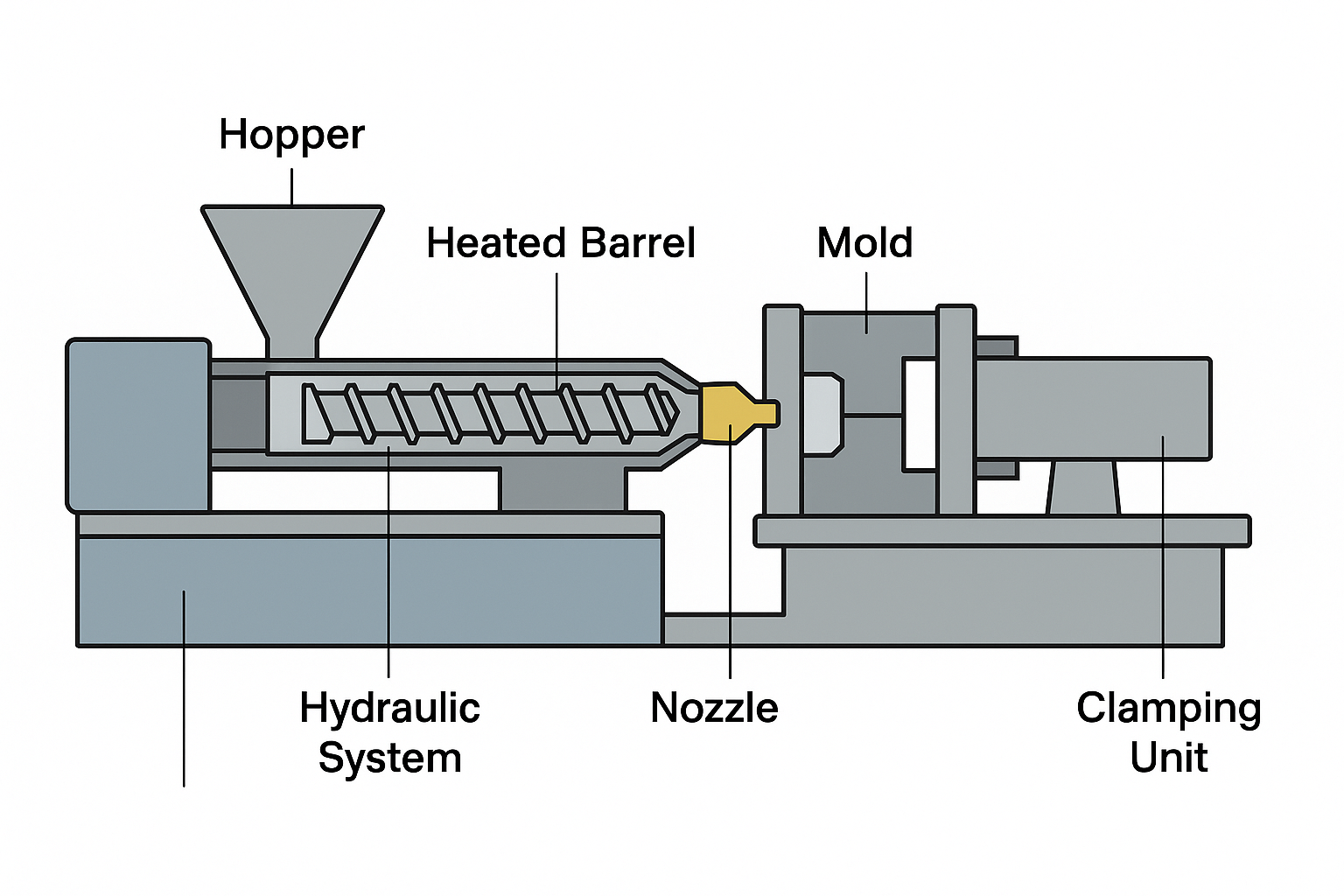
    Below is a diagram labeling the essential components:

    The machine consists of several critical sections. At the top is the hopper, which stores and delivers raw plastic pellets into the machine. The pellets then move into the heated barrel, where a rotating screw conveys them forward while gradually heating and melting the plastic. This combination of shear and heat ensures thorough melting and homogenization. The melted polymer is then pushed forward through the nozzle, which acts as the connection point between the injection unit and the mold. The mold is where the final part is shaped — molten plastic fills the cavity, cools, and solidifies to match the mold’s geometry. The clamping unit applies strong force to keep the mold halves shut during injection, preventing the material from leaking out. Finally, the hydraulic or electric drive system provides the power for screw rotation, injection, and clamping.


    Understanding each part and its role is essential because any malfunction (like poor heating, low clamp force, or worn screws) will directly affect product quality.


    Start-Up and Operation Procedure


    Operating an injection molding machine involves a series of precise steps. Let’s expand on each:


    1. Pre-Start Checks

    Before switching on the machine, safety comes first. Operators should always wear heat-resistant gloves, safety glasses, and protective clothing. Next, all utilities such as hydraulic oil, cooling water, and compressed air must be verified. Without proper water flow, molds can overheat and damage. If using moisture-sensitive polymers like nylon or PET, proper drying in a hopper dryer is crucial to prevent degradation and poor part quality.


    2. Machine Start-Up

    Once utilities are confirmed, power on the machine and turn on heaters. It typically takes 20–30 minutes for the barrel zones and mold to stabilize at their set temperatures. During this period, the screw should be jogged gently after heating to ensure free rotation. Purging the barrel removes any residual material from previous runs, avoiding contamination and defects.


    3. Mold Setup

    The mold must be mounted securely and aligned in the clamping unit. Cooling lines are connected to regulate temperature, and electrical heaters or sensors are wired if needed. A mold safety check ensures the ejectors, guide pins, and parting line are working properly.


    4. Setting Process Parameters

    Operators set the barrel temperature profile, injection speed, pressure, holding time, and clamp force. Each setting must be chosen carefully to match the material’s processing window and the part’s requirements. Incorrect parameters can result in short shots, flashing, or part warpage.


    Typical Settings for Different Polymers:


    • Polypropylene (PP): Barrel 180–230 °C, Mold 30–60 °C, Injection Pressure 800–1200 bar, Injection Speed medium-high, Cooling 15–25 s.


    • ABS: Barrel 200–250 °C, Mold 40–80 °C, Injection Pressure 1000–1500 bar, Injection Speed medium, Cooling 20–30 s.


    • Polycarbonate (PC): Barrel 260–320 °C, Mold 80–120 °C, Injection Pressure 1200–1800 bar, Injection Speed medium-low, Cooling 25–40 s.


    • Nylon (PA6): Barrel 230–280 °C, Mold 60–90 °C, Injection Pressure 1000–1500 bar, Injection Speed medium, Cooling 20–35 s.


    • PET: Barrel 250–280 °C, Mold 90–120 °C, Injection Pressure 1200–1600 bar, Injection Speed high, Cooling 15–25 s (must be dried thoroughly).


    5. Trial Shots

    During initial runs, the mold is closed slowly in setup mode. Injection is done manually at lower speeds to prevent damage. Parts are inspected for quality defects such as weld lines, bubbles, or incomplete filling. Adjustments are made gradually.


    6. Production Mode

    Once stable, the machine is switched to automatic cycle mode. The process repeats: clamping, injecting, packing, cooling, opening, and ejection. Continuous monitoring is necessary to detect process drifts.


    7. Shutdown

    To shut down, stop feeding material, purge the barrel, and turn off heaters. Hydraulic pressure should be relieved, and the mold should be left open. The area must be cleaned, and records logged for future reference.


    Temperature Profile Example


    The temperature profile along the barrel is one of the most important settings. The rear zone must be lower to avoid premature softening or bridging of pellets, while the middle and front zones gradually increase to ensure full melting. The nozzle is often slightly cooler to prevent drooling of molten material.


    Here’s a typical ABS temperature profile:


    In this graph, we see the temperature gradually rising from the rear zone (200 °C) to the front zone (240 °C), then slightly decreasing at the nozzle (230 °C). This balance ensures smooth melting and avoids overheating or material degradation.

    Injection Pressure Profile


    Injection pressure is another critical variable. Too little pressure results in incomplete filling, while too much can cause flash, mold damage, or material stress. A controlled pressure profile helps balance flow and quality.


    In this graph, the cycle is divided into four stages:


    • Filling: Rapid rise in pressure pushes molten plastic into the mold cavity.
    • Packing: High pressure is maintained to fill shrinkage and ensure complete part formation.
    • Holding: Pressure gradually decreases to maintain the shape while preventing overpacking.
    • Cooling: Pressure drops to zero as the part solidifies.


    This staged approach prevents common defects like short shots, sink marks, or flashing.

    Injection Speed

    Injection speed controls how fast the molten plastic fills the mold cavity. High speeds are needed for thin-walled parts to avoid premature solidification, while lower speeds are preferred for thick parts to reduce stress and prevent flow marks.


    • Thin parts → high speed (200–500 mm/s) ensures rapid filling.
    • Thick parts → lower speed avoids voids and jetting.
    • Amorphous plastics like ABS, PS, and PMMA generally tolerate higher speeds.
    • Semi-crystalline plastics like PP, PA, and POM often require slower speeds to avoid defects.


    Modern machines allow multi-stage speed control: starting fast to fill most of the cavity, then slowing down near the end to prevent defects at the gate or weld lines.


    Typical Speed Guidelines for Common Polymers:


    • PP: Medium-high speed, 80–150 mm/s.
    • ABS: Medium speed, 60–120 mm/s.
    • PC: Medium-low speed, 40–100 mm/s (to avoid stress).
    • PA (Nylon): Medium speed, 70–120 mm/s.
    • PET: High speed, 120–200 mm/s (thin-wall applications).

    Machine Settings Checklist


    The settings of an injection molding machine are interconnected. Here’s how each plays a role:


    • Temperature: Determines melting and flowability of the resin.
    • Injection Unit: Speed, injection pressure, holding pressure/time, screw speed, and back pressure all influence melt preparation and delivery.
    • Clamping Unit: Clamp force prevents mold opening under cavity pressure, while ejector stroke and speed define how parts are removed.
    • Cycle Timing: Each phase (injection, holding, cooling, mold open/close) is carefully timed to ensure repeatability.
    • Safety Systems: Interlocks, decompression (suck-back), and alarms prevent accidents and material wastage.


    Each parameter must be set based on material datasheets, mold design, and past process knowledge.

    Mold Removal (Ejection) Types


    Ejection of parts from the mold can be achieved in several ways:


    • Ejector pins are the most common, pushing the part out with small round pins. They may leave minor marks.
    • Sleeve ejection is used for cylindrical parts, like bottle caps, providing uniform removal force.
    • Stripper plates push out thin or flat parts uniformly without pin marks.
    • Air ejection blows compressed air between part and cavity to break suction.
    • Unscrewing mechanisms are used for threaded parts, rotating the core to avoid damage.
    • Robotic/manual removal handles delicate or complex shapes that require special care.


    Each method is chosen depending on the geometry and precision requirements of the part.

    ⚠️ Disclaimer

    All information provided in this blog is for educational purposes only. It is not intended for practical machine operation at home or without professional supervision. Injection molding machines operate at very high temperatures and pressures, making them dangerous if mishandled. We do not take responsibility for any consequences of using this data to run equipment.
  • Structure and Bonding in Chemistry: Understanding Covalent Bonds, Lewis Structures, and Molecular Shapes

    Structure and Bonding in Chemistry: Understanding Covalent Bonds, Lewis Structures, and Molecular Shapes

    Chemical bonds and the structure of molecules are ideas based on the modern atomic model. They help us understand how matter behaves and their chemical and physical properties.


    What is a Chemical Bond?


    Most atoms are not stable on their own, so they bind chemically with other atoms to become stable.


    One of the most common ways atoms bond is through covalent bonding and understanding how it works gives us insight into the very structure of matter.

    What is a Covalent Bond?

    A covalent bond forms when two atoms share a pair of electrons. Each atom contributes one electron to the shared pair, creating a strong connection between them. This kind of bond can happen between atoms of the same element (like two oxygen atoms forming O₂) or between different elements (like hydrogen and oxygen forming H₂O).


    But why do atoms share electrons in the first place?  Stability Through Sharing

    Atoms are most stable when their outermost shell of electrons called the valence shell is full. Most elements aim to have eight electrons in their valence shell, a concept known as the octet rule.


    For elements in the second period of the periodic table (like carbon, nitrogen, oxygen, and fluorine), achieving an octet (8 valence electrons) leads to high stability. These elements bond with others in ways that help them complete their octet.

    While the octet rule works well for many elements, especially in the second period, there are exceptions.

    1. Expanded Octets

    Elements in the third period and beyond (like sulfur and phosphorus) have access to d orbitals in addition to s and p orbitals. This allows them to hold more than eight electrons in their valence shell.


    Examples:

    • SO₂ and SO₃ are molecules where sulfur has more than eight electrons around it.
    • Sulfur can hold up to 18 electrons because of its 3d orbitals.


    However, these d orbitals don’t always participate in bonding. In simple molecules like H₂S, sulfur still follows the octet rule without using its d orbitals.

    1. Electron-Deficient Compounds

    Some elements, especially beryllium (Be), boron (B), and aluminum (Al), often form compounds where the central atom ends up with fewer than eight electrons. These are known as electron-deficient molecules. These atoms still form stable compounds despite not completing an octet.


    Examples:

    • BeCl₂
    • BH₃
    • BCl₃
    • AlCl₃


    1. Odd-Electron Molecules

    Not all molecules have an even number of electrons. Some, like nitric oxide (NO) and nitrogen dioxide (NO₂), have odd numbers of electrons. These compounds cannot complete the octet rule for all atoms involved but still exist and play important roles in chemistry and biology.


    Special Case: Hydrogen

    Hydrogen is a unique element. It has only one electron and just one orbital (1s), so it achieves stability with just two electrons. This is called the duet rule, and it’s why hydrogen only forms one covalent bond.


    In Summary

    • Covalent bonds involve sharing electrons to help atoms achieve stable electron configurations.
    • Most atoms aim to follow the octet rule, but there are exceptions:
      • Expanded octets (elements with d orbitals)
      • Electron-deficient compounds (like those of B, Be, and Al)
      • Odd-electron molecules (like NO and NO₂)


    What is a Lewis Dot Structures?

    A Lewis dot diagram uses dots to represent valence electrons, the electrons in the outermost shell of an atom. These dots are placed around chemical symbols (like H, O, or Cl) to show how atoms share or transferelectrons when forming bonds.


    A Lewis dot-dash structure is an extension of this idea, where a line (or dash) replaces a pair of bonding electrons between two atoms. This makes it easier to see single, double, or triple bonds.


    How to Draw a Lewis Structure: The Step-by-steps

    1. Identify the Central Atom

    • Hydrogen and fluorine are usually not central atoms. They only form one bond.
    • The less electronegative atom (less greedy for electrons) is typically at the center.

     Example: In H₂O, oxygen is in the center, and hydrogens are on the outside.

    1. Count All Valence Electrons

    Add up the valence electrons from each atom.

    • For H₂O: O = 6 electrons, each H = 1 electron → 6 + 1 + 1 = 8 electrons
    • For ions:
      • Add electrons for negative charges (like OH⁻: 6 + 1 + 1 = 8).
      • Subtract electrons for positive charges (like NH₄⁺: 5 + 4 – 1 = 8).
    1. Create Single Bonds First

    Connect each outer atom to the central atom with a pair of dots or a dash, representing one bond.

    1. Complete the Octet Rule

    Distribute the remaining electrons to satisfy the octet rule (8 electrons around each atom), starting with the most electronegative atom.

    • For CCl₄, all four Cl atoms get three lone pairs (6 electrons each), and carbon forms four bonds (one with each Cl).
    1. Check and Assign Formal Charges

    Use this checklist:

    • Lone pair? Both electrons go to that atom.
    • Bonding pair? One electron goes to each atom.

    Compare this to how many electrons the atom normally has. If it’s more or less, assign a formal charge.

    Example: NH₂ has a -1 charge on nitrogen because it appears to have one extra electron compared to its usual 5.


    1. Rearranging for Stability

    Sometimes the structure you first draw isn’t the most stable. You may need to:

    • Convert lone pairs into bonding pairs to form double or triple bonds.
    • Reduce formal charges across the molecule.


    Example: For SO₃², you first draw 26 electrons. Then, adjust lone pairs to reduce charges and make a more stable structure. This might mean the sulfur ends up with more than 8 electrons—but that’s okay! Sulfur can expand its octet thanks to its d orbitals.


    Special Notes:

    • Hydrogen wants 2 electrons (not 8). It’s happy with just a duet.
    • Elements beyond the second period (like sulfur and phosphorus) can hold more than 8 electrons.
    • Electron-deficient elements (like Be, B, Al) can be stable with less than 8 electrons.
    • Molecules like NO and NO₂ may have odd numbers of electrons and still exist stably.


    Real-World Examples:

    How Molecules Take Shape: Dative Bonds & VSEPR Theory Explained


    What is a Dative Covalent Bond?  

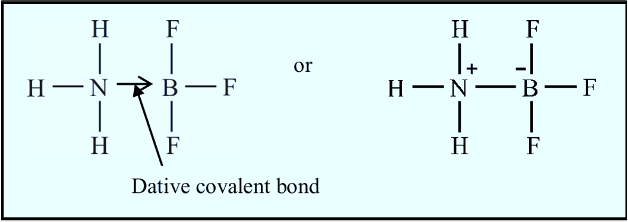
    Usually in covalent bonds, each atom shares one electron to form a shared pair. But sometimes, one atom donates both electrons and that’s when a dative covalent bond (also called a coordinate bond) is formed.

     How It Works:

    • One atom has a lone pair (a non-bonded pair of electrons).
    • Another atom has an empty orbital and needs electrons.
    • The atom with the lone pair donates the entire pair into the empty orbital.
    • This bond is often represented by an arrow (→) pointing from the donor to the acceptor.


    Examples:

    • NH₃ + BF₃ → H₃N→BF₃
      • Nitrogen has a lone pair.
      • Boron is electron deficient.
      • The arrow shows nitrogen donating a lone pair to boron.
    • BH₃ reacting with CO or CN also creates similar dative bonds.


    Dative Bonds in Complex Ions:

    • Transition metals like Cu² can also form dative bonds.
    • NH₃, H₂O, CO, or CN can donate lone pairs to the metal.
    • This forms complex ions, where multiple dative bonds hold everything together.


    VSEPR Theory: Predicting the Shape of Molecules

     (Valence Shell Electron Pair Repulsion Theory) Proposed by Gillespie and Nyholm, this theory says:


    Electron pairs around a central atom will spread out as far as possible to minimize repulsion.


    Types of Electron Pairs:

    1. Bonding pairs – Electrons shared between two atoms.
    2. Lone pairs – non-bonded electrons that stay with one atom.


    Lone pairs repel more strongly than bonding pairs because they are only influenced by one nucleus.


    Single, Double, and Triple Bonds:

    • Each bond type (single, double, or triple) is treated as one repulsive unit (also called a VSEPR unit).
      • Example: CO₂ has two double bonds, so it has 2 VSEPR units.
      • Example: HCN has a triple bond between C and N, but still only 1 repulsive unit for that bond.


     Electron Pair Geometry vs. Molecular Shape:

    There are three key terms you need to know:

    Bond angles are included in the geometry, but not required when stating just the shape.


    Repulsion Order:

    When determining molecule shape, keep in mind:


    This is why molecules like NH₃ and H₂O have less than ideal bond angles the lone pairs push the bonding pairs closer together.


    VSEPR in Action:

    Here’s a quick guide to the shapes based on the number of repulsive units:

    From Atoms to Angles: How VSEPR Shapes Molecules


    Let’s explore the main electron pair geometries and how they lead to different molecular shapes.

    1. Linear Geometry

    • Number of VSEPR units: 2
    • Bond angle: 180°
    • Example molecules: CO₂, BeCl₂

     Why it’s linear: The two bonding pairs of electrons stay as far apart as possible on opposite sides of the central atom forming a straight line.

    1. Trigonal Planar Geometry

    • Number of VSEPR units: 3
    • Bond angle: 120°

    All bonding pairs:

    • Example: BF₃, SO₃, HCHO
    • Shape: Trigonal planar


    2 bonding + 1 lone pair:

    • Example: SO₂
    • Shape: Angular (Bent) due to lone pair repulsion

     Why it bends: The lone pair pushes the bonding pairs closer together, changing the shape.

    1. Tetrahedral Geometry


    • Number of VSEPR units: 4
    • Bond angle: 109.5°

    All bonding pairs:

    • Example: CH₄
    • Shape: Tetrahedral


    3 bonding + 1 lone pair:

    • Example: NH₃
    • Shape: Trigonal pyramidal

    2 bonding + 2 lone pairs:

    • Example: H₂O
    • Shape: Angular (Bent)


    Note: As lone pairs increase, bond angles decrease due to increased repulsion.

    1. Trigonal Bipyramidal Geometry
    • Number of VSEPR units: 5


    All bonding pairs:

    • Example: PCl₅
    • Shape: Trigonal bipyramidal


    4 bonding + 1 lone pair:

    • Example: SCl₄
    • Shape: See-saw (Distorted tetrahedral)


    3 bonding + 2 lone pairs:

    • Example: ICl₃
    • Shape: T-shaped


    2 bonding + 3 lone pairs:

    • Example: XeF₂
    • Shape: Linear

    Why shapes vary: Lone pairs take up more space, distorting ideal angles and leading to irregular shapes.

    1. Octahedral Geometry

    • Number of VSEPR units: 6
    • Bond angle: 90°

     All bonding pairs:

    • Example: SF₆
    • Shape: Octahedral

    5 bonding + 1 lone pair:

    • Example: XeOF₄
    • Shape: Distorted square pyramidal 

    4 bonding + 2 lone pairs:

    • Example: XeF₄
    • Shape: Square planar


    Visual trick: Connect all atoms with imaginary lines, and you’ll get 3D shapes like a pyramid, T-shape, or octahedron.


    Quick Recap: VSEPR Shape Chart


    Why Does This Matter?

    The shape of a molecule affects:

    • Polarity (whether a molecule has a positive and negative end)
    • Reactivity (how it behaves in chemical reactions)
    • Physical properties like boiling point, solubility, and more.
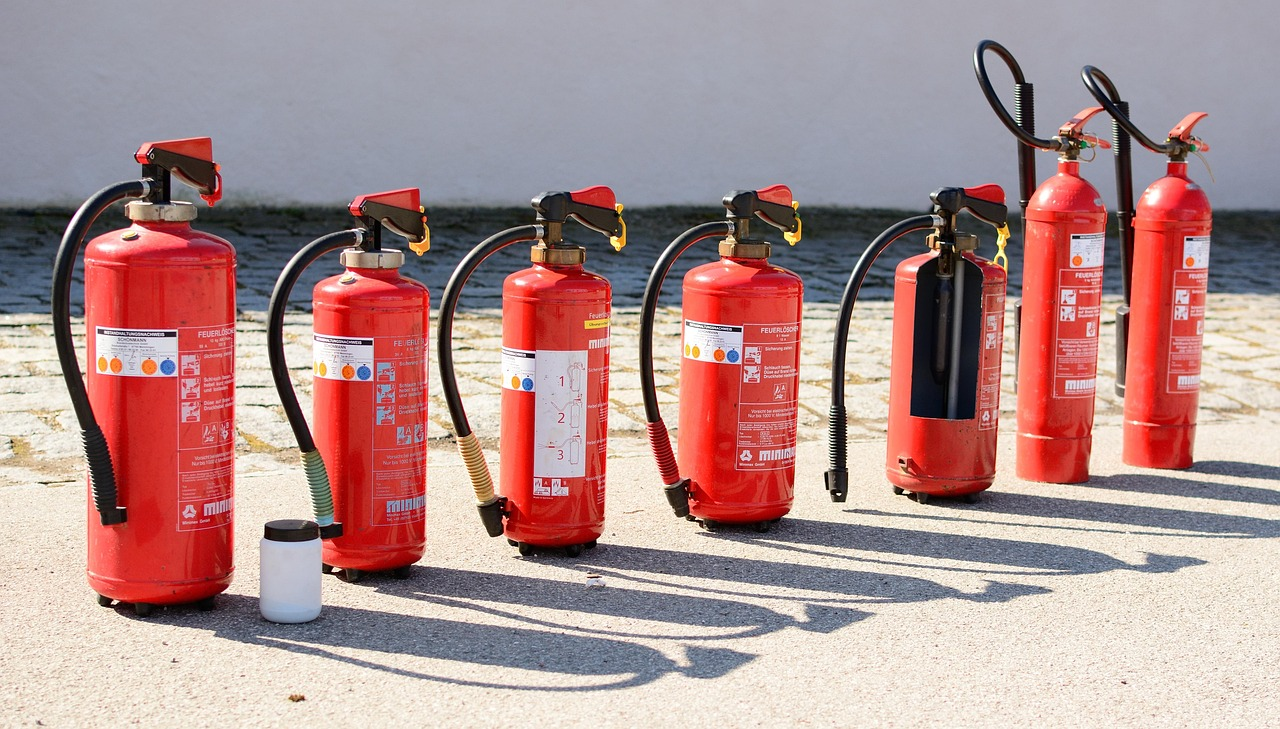
  • Fire and Fire Extinguishers: A Complete Safety Guide

    Fire and Fire Extinguishers: A Complete Safety Guide

    Fires are among the most common and dangerous emergencies in homes, workplaces, and industrial plants. Understanding the nature of fire and knowing how to properly use fire extinguishers can prevent small incidents from becoming life-threatening disasters.

    This guide covers the basics of fire science, types of fires, fire extinguisher classifications, selection, usage, and best practices for fire safety.


    🔥 What Is Fire?

    Fire is a chemical reaction called combustion, where a material rapidly reacts with oxygen, releasing heat, light, and various gases. It is both powerful and dangerous, making fire science essential in industrial safety and emergency response.

    🔺 The Fire Triangle and Tetrahedron

    To ignite and sustain a fire, three basic elements must be present—this is known as the Fire Triangle:

    1. Fuel – Any combustible material (solid, liquid, or gas) that can burn.

    2. Oxygen – Typically from the air, which contains about 21% oxygen to support combustion.

    3. Heat – The ignition source (e.g., spark, flame, friction, or hot surface) that raises the fuel to its ignition temperature.

    However, to fully understand how a fire sustains itself, modern fire science adds a fourth element, forming the Fire Tetrahedron:

    1. Chemical Chain Reaction – Once a fire starts, this self-sustaining chemical reaction keeps it going by continuously generating heat and free radicals.

    Remove any one of these four elements, and the fire will be extinguished.

    That’s why fire prevention and suppression strategies focus on eliminating at least one element—by cooling (removing heat), smothering (removing oxygen), starving (removing fuel), or disrupting the chemical reaction (using specialized extinguishing agents).


    🔥 Types of Fires (Fire Classes)

    Fires are categorized into classes based on the type of fuel involved:

    Using the wrong extinguisher on a fire class can be ineffective or dangerous.

    🧯 Types of Fire Extinguishers

    Fire extinguishers are designed to combat specific fire classes. Here’s a breakdown of common types:

    1. Water (APW – Air Pressurized Water)

    • Suitable for: Class A
    • Not for: B, C, D, K fires
    • Action: Cools the fire by soaking materials

    2. Foam

    • Suitable for: Class A & B
    • Action: Smothers fire and prevents vapor release

    3. Carbon Dioxide (CO₂)

    • Suitable for: Class B & C
    • Action: Displaces oxygen and cools electrical equipment
    • Note: Leaves no residue; not effective on Class A

    4. Dry Chemical (ABC Extinguishers)

    • Suitable for: Class A, B & C
    • Action: Interrupts chemical reaction and coats the material
    • Most versatile for general workplaces

    5. Dry Powder (Specialized)

    • Suitable for: Class D
    • Action: Separates fuel from oxygen
    • Not for: A, B, or C fires

    6. Wet Chemical

    • Suitable for: Class K
    • Action: Forms a soap-like substance (saponification) to cool and smother grease fires
    • Common in commercial kitchens

    How to Use a Fire Extinguisher: The PASS Method

    1. Pull the pin – Break the seal.

    2. Aim at the base of the fire – Not the flames.

    3. Squeeze the handle – Discharge the agent.

    4. Sweep from side to side – Cover the entire area.

    Tip: Always keep your back to the exit. Never fight a large or spreading fire—evacuate and call emergency services.


    Fire Extinguisher Color Codes (International Standards)


    Placement and Maintenance

    • Mount extinguishers in accessible locations (hallways, near exits)

    • Perform monthly visual inspections

    • Conduct annual servicing by certified personnel

    • Ensure signage is visible and readable

    • Train staff regularly on how to use them


    Fire Prevention Tips

    • Keep flammable materials away from heat sources

    • Do not overload electrical circuits

    • Maintain clean workspaces (free of combustible dust and clutter)

    • Use proper storage for chemicals

    • Perform regular fire drills and risk assessments


    Fire Risk in Chemical Plants

    In industrial environments, especially chemical plants, fire risks are heightened due to:

    • Flammable chemicals

    • Pressurized gases

    • Electrical panels

    • Hot work (welding, grinding)

    Additional Safety Measures:

    • Install flame detectors and gas sensors

    • Use explosion-proof equipment

    • Maintain emergency shutdown systems

    • Train staff in fire scenarios specific to the plant’s processes


    Final Thoughts

    Fire safety is a shared responsibility. Whether you’re at home, at work, or in an industrial setting, knowing how fires start, how to prevent them, and how to respond can save lives and property.

    “In an emergency, your best weapon is preparation. Don’t wait until the fire starts—be ready before it ever does.”

  • Mechanical Drawings in Engineering: Types, Symbols, and Best Practices

    Mechanical Drawings in Engineering: Types, Symbols, and Best Practices

    Introduction

    Mechanical drawings are the language of engineering design. Whether you’re fabricating a machine part, constructing a plant layout, or designing a product assembly, mechanical drawings ensure everyone—from engineers to machinists—understands exactly what needs to be built.

    In this post, we’ll explore the types of mechanical drawings, essential symbols and notations, and best practices for reading and creating technical drawings.


    1.0 What Are Mechanical Drawings?

    A mechanical drawing (also called an engineering drawing or technical drawing) is a precise, standardized representation of an object or system, created to communicate design intent. These drawings include:

    • Dimensions

    • Tolerances

    • Material specifications

    • Surface finishes

    • Assembly instructions

    They are used in mechanical, civil, structural, electrical, and manufacturing disciplines.


    2.0 Types of Mechanical Drawings

    Understanding the various types of mechanical drawings is essential for interpreting engineering documents:

    1. Detail Drawings

    • Focus on individual components

    • Include dimensions, materials, surface finishes, and tolerances

    • Used by machinists for part fabrication

    2. Assembly Drawings

    • Show how multiple parts fit together

    • Include part numbers, exploded views, and fastening methods

    • Often accompanied by a Bill of Materials (BOM)

    3. Sectional Drawings

    • Show interior details by cutting through an object

    • Useful for complex parts that can’t be fully understood externally

    4. Exploded Views

    • Show components spaced out along an axis

    • Ideal for understanding how parts assemble or disassemble

    5. Isometric Drawings

    • Represent 3D objects in 2D

    • Common in plant layouts and piping diagrams


    Example: Pressure Vessel Assembly Drawing Created Using SolidWorks

    This detailed mechanical drawing illustrates the complete assembly of a pressure vessel, modeled and drafted in SolidWorks.

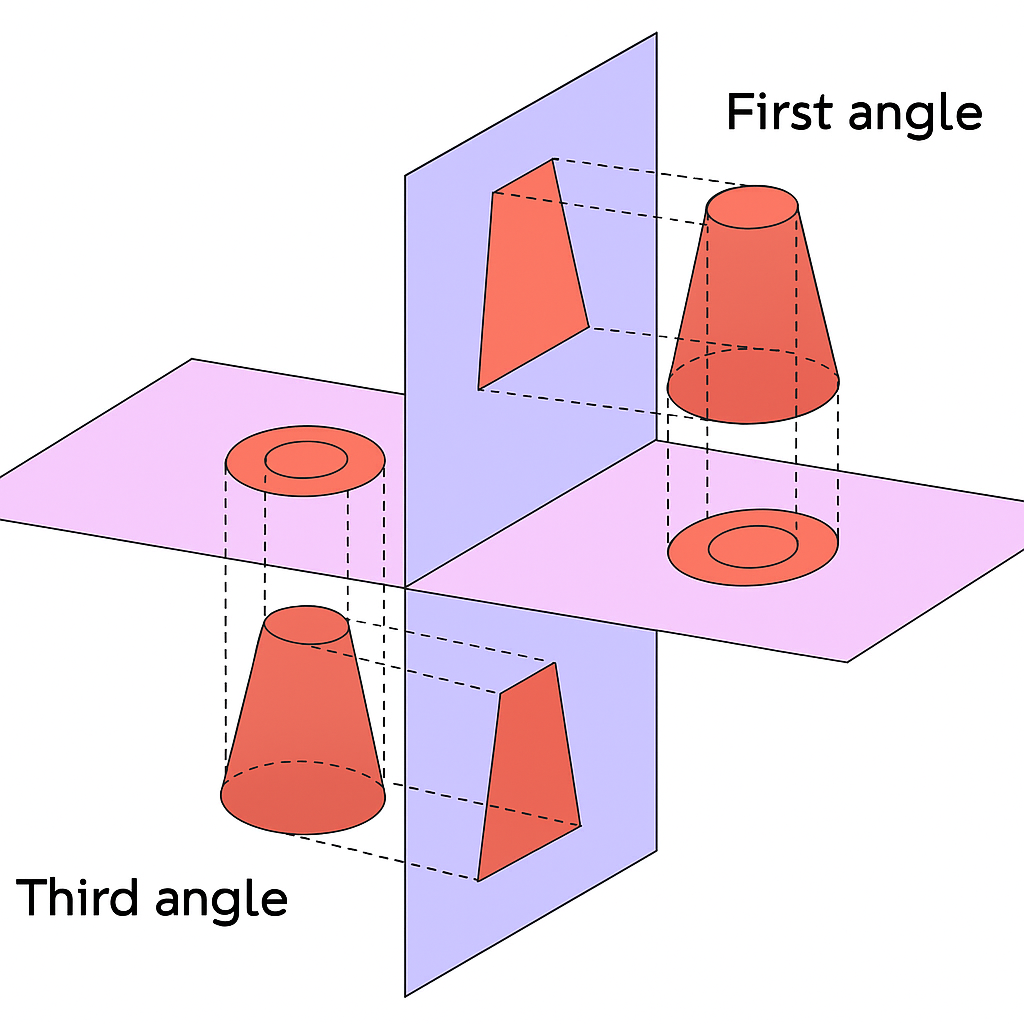
    Figure: Isometric Assembly View of a Pressure Vessel

    Figure: Vessel Drawing Front view, top view and side view


    3.0 Common Symbols and Notations in Mechanical Drawings

    Mechanical drawings use standardized symbols and conventions, as per ISO, ANSI, or ASME standards.

    Note: Always refer to the title block for drawing-specific tolerances and scale.


    4.0 Key Components of a Mechanical Drawing

    1. Title Block

      • Contains drawing number, title, date, author, revision, material, and scale.

    2. Views

      • Front, top, side, section, and isometric views for complete understanding.

    3. Dimensions

      • Linear, radial, angular—always in standardized units (e.g., mm or inches).

    4. Tolerances

      • Allowable variation in dimensions (important for manufacturability).

    5. Bill of Materials (BOM)

      • List of parts used in an assembly drawing, with quantities and part numbers.


    5.0 Best Practices for Reading Mechanical Drawings

    • Start with the title block and scale.

    • Identify main views (usually front view is most informative).

    • Follow dimension lines and notes carefully.

    • Review tolerances—they affect manufacturing and assembly.

    • Study section views for hidden features.

    • Look at material specifications and surface finish notes.


    6.0 Best Practices for Creating Mechanical Drawings

    1. Use Standard Templates – Stick to ISO or ASME drawing templates.

    2. Ensure Clarity – Avoid crowding; use proper line types and scales.

    3. Label Everything – Stream numbers, part names, notes, and units.

    4. Maintain Consistency – Uniform font, arrowhead size, and dimensioning style.

    5. Add Revision History – Track changes for version control.

    6. Verify Against CAD Models – Always cross-check 2D with 3D models.


    7.0 Software Tools for Mechanical Drawing

    Modern mechanical drawings are created using CAD (Computer-Aided Design) software. Popular tools include:

    • AutoCAD

    • SolidWorks

    • CATIA

    • PTC Creo

    • Fusion 360

    • Inventor

    These tools allow 2D drafting and 3D modeling, with built-in features for GD&T, BOMs, and simulations.


    8.0 Why Mechanical Drawings Matter

    Mechanical drawings ensure that what’s imagined can actually be manufactured. They:

    • Reduce errors and miscommunication

    • Standardize production and fabrication

    • Serve as official documentation

    • Enable collaboration across design, fabrication, and QA/QC teams

    • Ensure compliance with codes and engineering standards


    Conclusion

    Whether you’re a design engineer, student, machinist, or project manager, understanding mechanical drawings is essential. They form the backbone of engineering design communication and ensure that products are built correctly and safely.

    As you become more fluent in reading and creating these drawings, you’ll gain deeper insight into how machines and systems are conceived, designed, and brought to life.

  • Periodic Trends in the Periodic Table (s- and p-Block Elements)

    Periodic Trends in the Periodic Table (s- and p-Block Elements)

    The periodic table is more than a list of elements — it’s a powerful tool that reveals predictable patterns, or periodic trends, in the physical and chemical properties of elements. These trends arise from changes in atomic structure as we move across periods or down groups.

    In this guide, we focus on the periodic trends shown by s- and p-block elements, following the Chemistry syllabus, including atomic and ionic sizes, ionization energy, electron gain energy, and electronegativity.


    Sizes of Atoms and Ions

    Atomic Size (Atomic Radius)

    Atomic size refers to the distance between the nucleus and the outermost electron shell.

    There are three commonly discussed atomic radii:

    • Van der Waals Radius: Half the distance between two non-bonded atoms in neighboring molecules.

    • Covalent Radius: Half the distance between two nuclei in a covalent bond.

    • Metallic Radius: Half the distance between nuclei of two adjacent atoms in a metallic lattice.

    📌 Covalent radius is typically used when discussing nonmetals; metallic radius for metals.

    Periodic Trends in Atomic Radii

    • Across a Period (→): Atomic radius decreases
      → Due to increasing nuclear charge pulling electrons closer.

    • Down a Group (↓): Atomic radius increases
      → Due to addition of new electron shells.


    Electron Configurations of Ions

    When an atom loses electrons to form a cation, the electrons are removed first from the orbitals with the highest principal quantum number (n).
    For instance, in a sodium atom with the configuration 1s² 2s² 2p⁶ 3s¹, the electron is lost from the 3s orbital, as it has the highest value of n.

    When atoms become ions:

    • Cations (positive ions): Lose electrons → become smaller
      → Sometimes lose an entire outer shell.

    • Anions (negative ions): Gain electrons → become larger
      → Increased electron-electron repulsion expands the electron cloud.

    Example:

    • Na (Z = 11): 1s² 2s² 2p⁶ 3s¹
      → Na⁺ = 1s² 2s² 2p⁶ (smaller size)

    • Cl (Z = 17): 1s² 2s² 2p⁶ 3s² 3p⁵
      → Cl⁻ = 1s² 2s² 2p⁶ 3s² 3p⁶ (larger size)

    Periodic Trends in Ionic Radii

    The radii of cations and anions, compared to their respective parent atoms (in picometres, pm), are shown in the figure below.

    • Cationic radii are smaller than atomic radii.

    • Anionic radii are larger than atomic radii.

    • Across a period (for isoelectronic species): Ionic radii decrease with increasing nuclear charge.

    • Down a group: Ionic radii increase due to added shells.

    • An isoelectronic series refers to a group of atoms or ions that all have the same number of electrons.
      For example, the species O²⁻, F⁻, Ne, Na⁺, and Mg²⁺ each possess 10 electrons. Within such a series, as the atomic number increases, the nuclear charge also increases. Since the electron count stays the same, a stronger attraction is exerted by the nucleus on the electrons, causing the ionic radius to decrease progressively across the series.


    Ionization Energy

    Ionization energy (IE) is the energy required to remove one mole of electrons from one mole of gaseous atoms.

    • The first ionization energy (I₁) is the energy needed to remove the outermost, most weakly held electron from a neutral atom in the gas phase. For instance, in the case of lithium, the first ionization involves the reaction:

    Li(g) → Li⁺(g) + e⁻

    • The second ionization energy (I₂) is the energy required to remove a second electron — this time from a positively charged ion (monovalent cation) to form a doubly charged ion (divalent cation). For lithium, this process is:

    Li⁺(g) → Li²⁺(g) + e⁻

    • Each successive ionization energy is higher than the previous one, as it’s increasingly difficult to remove electrons from an already positively charged ion.
    • Ionization energy increases with each successive electron removed:
      I₁ < I₂ < I₃, and so on.

    • Reason for the increase:
      Each electron is removed from a more positively charged ion, requiring more energy to overcome the stronger attraction to the nucleus.

    • Sharp jump in ionization energy:
      A significant increase occurs when an inner-shell electron is removed after all outer-shell electrons have been taken.

    • Why inner electrons require more energy:
      Inner-shell electrons are closer to the nucleus and experience a stronger electrostatic pull, making them harder to remove.

    Periodic Trends in First Ionization Energies

    • Across a Period: IE increases
      → Greater nuclear attraction and smaller size make it harder to remove electrons.

    • Down a Group: IE decreases
      → Outer electrons are further from the nucleus and shielded by inner shells.

    Detail diagrams of first ionization energy variation are given below.

    Variation of First Ionization Energies Across Periods 1 and 2

    The diagram shows how the first ionization energy changes as we move left to right across the first (H to He) and second (Li to Ne) periods of the periodic table.

    Key Trends and Reasons:

    • General Increase Across a Period:
      Ionization energy generally increases from left to right across both periods.
      🔹 This is because the nuclear charge increases (more protons in the nucleus), pulling electrons closer and more tightly, which makes them harder to remove.

    • Same Shell, Increasing Attraction:
      Even though all elements in a period have electrons in the same principal energy level, the increasing nuclear charge leads to a stronger attraction, so more energy is required to remove an electron.

    • Notable Exceptions:

      • Between Be and B, and N and O, there is a slight drop in ionization energy.

        • Boron vs. Beryllium: The 2p electron in boron is slightly easier to remove than the 2s electron in beryllium due to higher energy and shielding.

        • Oxygen vs. Nitrogen: In oxygen, electron pairing in the 2p orbital causes electron–electron repulsion, making it easier to remove one electron compared to nitrogen.

    This pattern highlights how atomic structure, particularly nuclear charge and electron configuration, influences the energy needed to remove electrons, helping us understand chemical reactivity and periodic trends.

    Note: Small dips occur due to electron pairing and subshell stability (e.g., Be vs. B, N vs. O).


    Electron Gain Energy (Electron Affinity)

    Electron gain energy refers to the energy change that occurs when an electron is added to a neutral atom in the gaseous state. For most elements, this process releases energy, meaning the value is negative.

    For instance, when a chlorine atom gains an electron, it releases -349 kJ mol⁻¹, indicating that the process is energetically favorable:
    Cl(g) + e⁻ → Cl⁻(g) ΔE EG = –349 kJ mol⁻¹

    However, some atoms have positive electron gain energy values, such as beryllium (Be) and nitrogen (N).
    This happens because:

    • Be has a stable 2s² configuration.

    • N has a half-filled 2p³ subshell.
      In both cases, adding another electron would cause electron–electron repulsion, making the process energetically unfavorable.

    Examples:
    N(g) + e⁻ → N⁻(g) ΔE EG = +134 kJ mol⁻¹
    Be(g) + e⁻ → Be⁻(g) ΔE EG = +231 kJ mol⁻¹

    Periodic Trends:

    • Across a period: Electron gain energy becomes less positive (or more negative), meaning atoms are more likely to gain electrons.

    • Down a group: It becomes more positive, indicating decreased tendency to accept electrons due to increased atomic size and shielding.


    Relationship Between Electron Gain Energy and Electron Affinity

    By international convention:

    Electron gain energy (ΔE EG) = – Electron affinity (EA)

    So, electron affinity represents the energy released when an electron is added to a gaseous atom, and it is numerically equal but opposite in sign to ΔE EG.

    For example:
    A⁻(g) → A(g) + e⁻ ΔE = EA,
    which is the reverse of the electron gain process.

    In summary, electron affinity is a key property that reflects how strongly an atom attracts an added electron and it closely mirrors the trends and behavior observed in electron gain energy.

    • If energy is released, the value is negative → Atom strongly attracts electrons.

    • If energy is absorbed, the value is positive → Atom resists gaining electrons.

    Periodic Trends

    • Across a Period: Electron gain energy becomes more negative (more exothermic).

    • Down a Group: Becomes less negative → Larger atoms attract extra electrons less strongly.

    📌 Halogens have the most negative electron affinities.
    📌 Noble gases have positive electron gain energy — they don’t readily gain electrons.


    Electronegativity

    Electronegativity is the ability of an atom in a chemical bond to attract bonding electrons.

    • Measured using Pauling scale (F = 3.98 is the highest).

    • Not an actual energy value, but a relative scale.

    The Role of Electronegativity in Chemical Bonding

    Electronegativity is a key concept in chemistry—it helps us understand how atoms interact when they bond. By looking at the difference in electronegativity between two atoms, we can predict the type of bond they will form:

    • Nonpolar covalent bond: Formed when the electronegativity difference is less than 0.4. Electrons are shared almost equally.

    • Polar covalent bond: Occurs when the difference falls between 0.4 and 1.7. Electrons are shared unequally, creating partial charges on atoms.

    • Ionic bond: Forms when the difference is greater than 1.7. One atom effectively takes an electron from the other.

    Understanding this helps us predict a compound’s properties like polarity, solubility, and reactivity.


    Electronegativity of Fluorine, Oxygen, and Chlorine

    Among all elements, fluorine tops the electronegativity chart—it has the strongest tendency to attract electrons in a bond. Next comes oxygen, followed by chlorine.

    What does this mean in practice?

    • Fluorine is almost always assigned a negative oxidation state, no matter what it’s bonded to. Its extreme electronegativity makes it highly reactive—it aggressively pulls electrons toward itself.

    • Oxygen also tends to be negative in compounds, except in rare cases like oxygen-fluorine compounds, where fluorine’s stronger pull takes precedence.

    • Chlorine, while slightly less electronegative, still shows strong electron-attracting behavior, contributing to its reactivity in halogen reactions.


    Why Noble Gases Don’t Have Electronegativity Values

    You won’t find electronegativity values for noble gases (like helium, neon, or argon) on most charts. That’s because these elements don’t usually form chemical bonds—they already have full outer electron shells and are generally inert. Since electronegativity is about how strongly an atom attracts electrons in a bond, it doesn’t apply well to noble gases under normal conditions.


    How to Determine the Electronegativity of a Molecule

    To estimate the electronegativity behavior in a molecule, examine each individual bond:

    1. Identify the two atoms involved in the bond.

    2. Look up their electronegativity values (typically found on a periodic table).

    3. Calculate the difference between the two.

    The magnitude of this difference tells you how polar that bond is:

    • Smaller difference → more equal sharing → nonpolar

    • Larger difference → unequal sharing → polar or even ionic

    This approach is especially useful in predicting molecular geometry, polarity, and how the molecule will interact with others (e.g., in solvents or reactions).

    Periodic Trends

    • Across a Period: Electronegativity increases
      → Due to smaller size and higher nuclear charge.

    • Down a Group: Electronegativity decreases
      → Atoms are larger and exert weaker pull on bonding electrons.


    Summary Table of Periodic Trends (s- and p-Block Elements)


    Final Tips for Students

    • Always relate trends to atomic structure: shell number, nuclear charge, and shielding.

    • Practice comparing elements in same period or group.

    • Be familiar with exceptions and reasons behind anomalies (like subshell stability).

    • Link these trends to chemical properties such as reactivity, bonding, and compound formation.

  • Heat Exchangers: Common Failures, Causes, and Prevention Strategies

    Heat exchangers are vital to nearly every industry, including chemical processing, power generation, oil and gas, HVAC, and pharmaceuticals. These systems operate based on core principles of thermodynamics — transferring heat from one fluid to another without mixing.

    Despite having no moving parts, heat exchangers are still prone to various types of failures due to thermal, mechanical, and chemical stresses. This guide explores the most common heat exchanger failures, their causes, and how engineers can prevent them to ensure operational efficiency and long-term reliability.


    How Heat Exchangers Work

    Heat exchangers enable thermal energy transfer between two or more fluids. This process follows the Zeroth, First, and Second Laws of Thermodynamics. They are classified by:

    • Fluid Flow Configuration: Co-current, counter-current, crossflow, hybrid

    • Construction Method: Recuperative vs. regenerative, direct vs. indirect

    • Heat Transfer Mechanism: Single-phase or two-phase


    Common Industrial Heat Exchanger Types


    Common Heat Exchanger Failures and How to Prevent Them

    1. Mechanical Failures

    1.1 Metal Erosion

    • Cause: High fluid velocity erodes tube walls, especially at bends and entrances.

    • Symptoms: Horseshoe-shaped erosion, thinning walls.

    • Prevention:

      • Control inlet velocities.

      • Use erosion-resistant materials.

      • Add impingement baffles at high-velocity zones.

    1.2 Water or Steam Hammer

    • Cause: Sudden pressure surges due to rapid valve closure or steam-condensate interaction.

    • Effects: Tube rupture or collapse.

    • Prevention:

      • Install steam traps and vacuum breakers.

      • Use modulating control valves.

      • Ensure proper drainage and venting.

    1.3 Vibration

    • Cause: High shell-side velocities or nearby vibrating machinery.

    • Result: Tube wall erosion, fatigue cracks at baffles and U-bends.

    • Prevention:

      • Limit shell-side fluid velocity.

      • Use proper tube support spacing.

      • Isolate exchanger from vibration sources.

    1.4 Thermal Fatigue

    • Cause: Repeated heating and cooling cycles, especially in U-bends.

    • Prevention:

      • Minimize temperature cycling.

      • Use flexible tube materials.

      • Reduce large temperature gradients.

    1.5 Freeze-Up

    • Cause: Fluid freezing in tubes due to winter shutdown or failed temperature control.

    • Prevention:

      • Use antifreeze solutions.

      • Drain systems during shutdowns.

      • Monitor fluid temperature consistently.

    1.6 Thermal Expansion

    • Cause: Overheating with no expansion relief (e.g., steam trapped inside).

    • Prevention:

      • Install relief valves.

      • Use expansion tanks.

      • Avoid deadheading.

    1.7 Loss of Cooling Water

    • Effect: Overheating causes tubing to warp or melt.

    • Prevention:

      • Use flow sensors and alarms.

      • Maintain backup cooling systems.

      • Regular maintenance of control valves.


    2. Chemical Corrosion Failures

    2.1 Galvanic, Crevice & Pitting Corrosion

    • Cause: Electrochemical reactions from dissimilar metals or stagnant fluids.

    • Prevention:

      • Use compatible materials.

      • Avoid crevices in design.

      • Ensure proper flow rates.

    2.2 Corrosion-Fatigue

    • Combination Failure: Mechanical stress ruptures protective oxide layers, exposing metal to corrosion.

    • Prevention:

      • Control vibration and thermal cycling.

      • Choose corrosion-resistant alloys.

    2.3 Erosion-Corrosion

    • Cause: High velocity removes protective film, accelerating corrosion.

    • Prevention:

      • Reduce velocity in vulnerable areas.

      • Use surface treatments or alloy upgrades.


    3. Fouling Failures

    Fouling refers to the unwanted deposition of materials on heat exchanger surfaces, reducing efficiency and increasing pressure drops.

    💡 Pro Tip: Design with 25–30% extra surface area to account for eventual fouling in shell and tube exchangers.


    Summary of Heat Exchanger Failure Modes


    ✅ Best Practices for Preventing Heat Exchanger Failures

    • Choose materials based on fluid chemistry and temperature

    • Control fluid velocity to prevent erosion and fouling

    • Include pressure relief valves and drain lines

    • Design for ease of cleaning and inspection access

    • Implement predictive maintenance and routine monitoring

    • Ensure temperature control to avoid thermal shock and freeze-ups


    Final Thoughts

    Heat exchangers may seem passive, but they’re critical to plant performance and energy efficiency. Understanding the common failure modes helps engineers design better systems and implement proactive maintenance to minimize downtime and extend equipment life.

    Whether you’re managing a refinery, a power plant, or a chemical process unit, identifying and mitigating these failure risks can result in safer, more reliable, and cost-effective operations.

  • Types of Heat Exchangers

    Types of Heat Exchangers

    Heat exchangers are critical components in nearly every chemical process plant. Whether you’re heating, cooling, condensing, or evaporating fluids, heat exchangers enable efficient thermal energy transfer between two or more streams — without mixing them.

    This guide explores the types of heat exchangers used in industry, how they work, where they’re applied, and how to choose the right type for your process.

    What Is a Heat Exchanger?

    A heat exchanger is a device that facilitates the transfer of thermal energy from one fluid (liquid or gas) to another. In most systems, the fluids are separated by a solid wall to prevent mixing, allowing heat transfer without direct contact.

    Heat exchangers are used in:

    • Reactors (for temperature control)

    • Distillation columns (reboilers and condensers)

    • Air conditioning and refrigeration

    • Waste heat recovery systems

    • Chemical and petrochemical plants

    Major Types of Heat Exchangers

    Heat exchangers are classified based on:

    • Flow arrangement

    • Construction

    • Number of fluids

    • Heat transfer surface design

    Here are the most commonly used types in the chemical and process industries:

    1. Shell and Tube Heat Exchanger

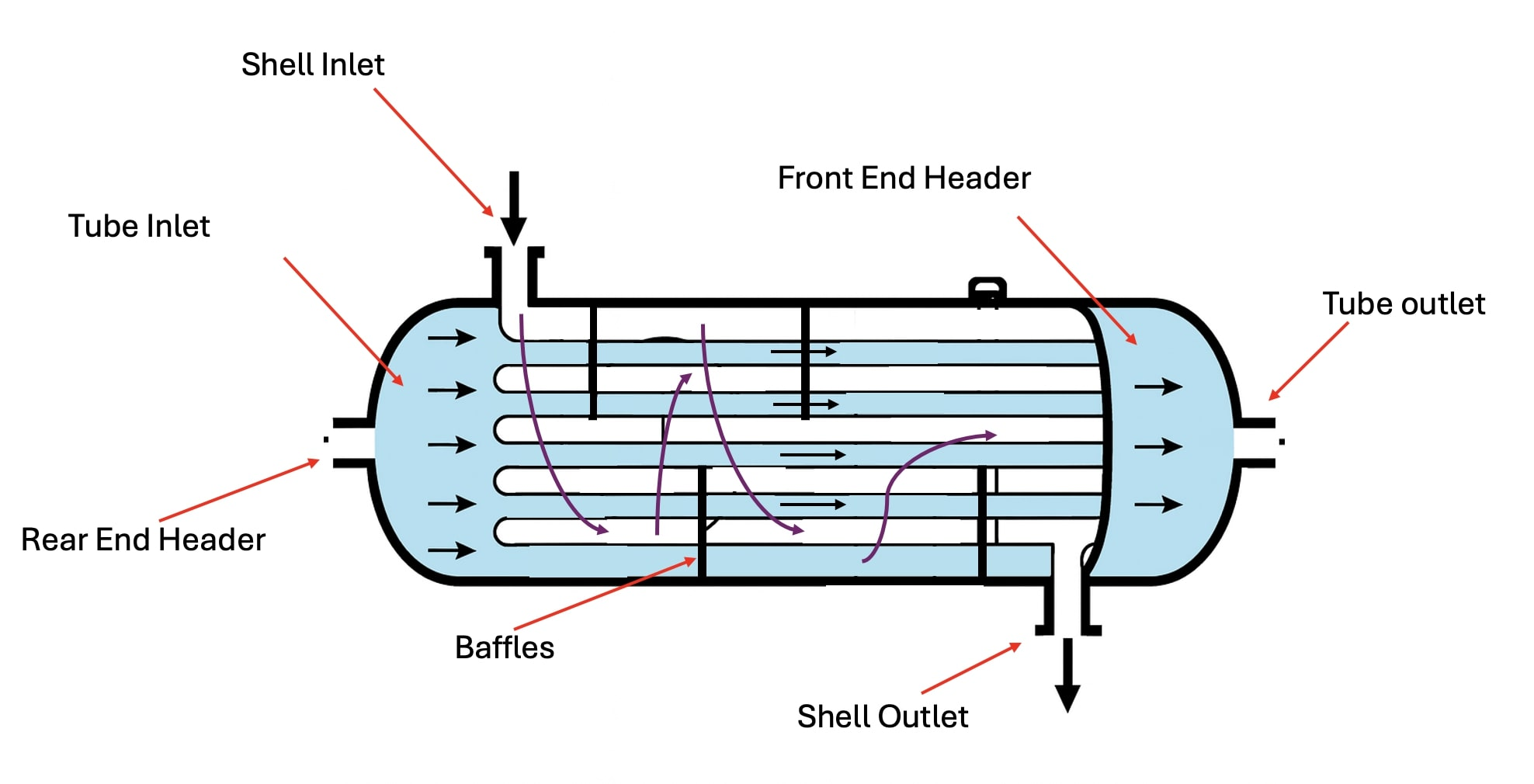
    A shell and tube heat exchanger is one of the most widely used types of heat exchangers in industrial applications. It consists of a series of tubes, called a tube bundle, enclosed within a cylindrical shell. One fluid flows through the tubes, while a second fluid flows over the tubes but inside the shell. This arrangement allows efficient heat transfer between the two fluids without direct contact. The design is highly versatile and can accommodate high pressures and temperatures, making it suitable for a variety of processes in industries such as chemical, petrochemical, and power generation.

    🔹 Features:

    • Can handle high pressure and temperature.

    • Easy to clean (especially the tube side).

    • Configurable for multiple passes.

    🔹 Common Uses:

    • Condensers in power plants

    • Reboilers and pre-heaters in distillation

    • Oil coolers, heat recovery systems

    Example: Steam condensing after a reactor.

    2. Plate Heat Exchanger

    A plate heat exchanger is constructed using a series of thin, corrugated metal plates stacked together to form multiple parallel channels. These plates are arranged in such a way that the two fluids flow through alternate channels, allowing for efficient heat exchange across the plate surfaces. The corrugation increases the surface area and promotes turbulence, enhancing heat transfer performance. Plate heat exchangers are compact, easy to clean, and ideal for applications requiring high thermal efficiency and close temperature approaches, such as in food processing, HVAC systems, and pharmaceutical industries.

    🔹 Features:

    • High heat transfer efficiency.

    • Compact and space-saving.

    • Ideal for low-viscosity fluids and moderate pressure.

    🔹 Common Uses:

    • Food and beverage processing

    • Pharmaceutical industry

    • Cooling water and closed-loop systems

    Example: Cooling process water using chilled water.

    3. Air Cooled Heat Exchanger (Fin Fan)

    An air cooled heat exchanger, commonly known as a fin fan cooler, uses ambient air as the cooling medium to remove heat from process fluids. It consists of tubes arranged in a bundle, typically equipped with extended surface fins to increase the heat transfer area. Large fans force air over the finned tubes, enhancing the cooling effect by maximizing contact between the air and the tube surfaces. This type of exchanger is especially useful in remote locations or plants where water is scarce, making it a preferred choice in oil refineries, gas processing facilities, and power plants.

    🔹 Features:

    • Eliminates the need for cooling water.

    • Low operating cost.

    • Suitable for remote or water-scarce areas.

    🔹 Common Uses:

    • Refineries and petrochemical plants

    • Gas compression systems

    Example: Cooling hot oil before storage.

    4. Double Pipe Heat Exchanger

    A double pipe heat exchanger consists of one pipe placed inside another, forming two concentric cylindrical paths for fluid flow. One fluid flows through the inner pipe, while the other flows through the annular space between the two pipes. The fluids can be arranged in either counterflow or parallel flow configurations, depending on the desired thermal performance. Known for its simple construction and ease of maintenance, the double pipe heat exchanger is commonly used for small-scale applications or when dealing with high-pressure fluids. Its modular nature also makes it easy to extend or modify for specific process requirements.

    🔹 Features:

    • Good for small flow rates.

    • Easy to maintain and modify.

    • Not suitable for very large heat duties.

    🔹 Common Uses:

    • Pilot plants

    • Laboratories

    • Small-scale processes

    Example: Heating solvent feed in a pilot plant.

    5. Spiral Heat Exchanger

    A spiral heat exchanger features a compact cylindrical design in which two fluids flow through separate spiral-shaped channels. These channels are formed by winding metal plates into a spiral configuration, creating a continuous flow path that enhances heat transfer and promotes self-cleaning. The spiral flow pattern ensures uniform velocity and minimizes dead zones, making this type of exchanger particularly effective for handling slurries, viscous fluids, or fluids prone to fouling. Its robust design and ease of maintenance make it suitable for challenging industrial processes such as wastewater treatment, chemical processing, and pulp and paper applications.

    🔹 Features:

    • Compact and self-cleaning.

    • Handles viscous or dirty fluids well.

    • High pressure and thermal efficiency.

    🔹 Common Uses:

    • Pulp and paper industries

    • Slurry heating in waste treatment

    • Crystallization units

    Example: Recovering heat from thick slurry effluent.

    6. Plate and Frame Heat Exchanger (Gasketed)

    The plate and frame heat exchanger is a type of plate heat exchanger that incorporates gaskets between the plates, allowing for easy assembly and disassembly. Like standard plate exchangers, it uses a series of thin, corrugated plates to create alternating flow channels for the two fluids. The gaskets not only direct the flow but also seal the fluids within their respective paths. This design makes it ideal for applications where regular cleaning, inspection, or maintenance is necessary, such as in the food and beverage, pharmaceutical, and dairy industries. Its modular construction also allows for capacity adjustments by adding or removing plates as needed.

    🔹 Features:

    • Excellent for hygiene-critical applications.

    • Easy to expand or repair.

    • Not suitable for very high pressures.

    🔹 Common Uses:

    • Dairy and food industries

    • Clean-in-place (CIP) processes

    Example: Milk pasteurization or yeast cooling.

    Flow Arrangement Types

    Understanding flow direction is key in design and efficiency:

    How to Select the Right Heat Exchanger

    Choosing the right heat exchanger depends on:

    • Fluid types (corrosive, fouling, viscous)

    • Temperature and pressure ranges

    • Fouling tendency and cleaning needs

    • Heat transfer rate required

    • Space availability and cost constraints

    • Ease of maintenance

    For example, if you are handling a corrosive, viscous fluid, a spiral heat exchanger or glass-lined shell and tube unit might be best.

    Summary: Heat Exchanger Selection Table

    Example Heat Exchanger Design: Shell-and-Tube Type

    Design Objective:

    Cool 10,000 kg/h of hot process fluid from 120°C to 60°C using cooling water entering at 30°C and exiting at 50°C.

    Given Data:

    Step 1: Calculate Heat Duty (Q)

    Step 2: Cooling Water Flow Rate

    Step 3: Log Mean Temperature Difference (LMTD)

    Step 4: Estimate Required Heat Transfer Area (A)

    Assume an overall heat transfer coefficient (U) for clean water-steam exchange:

    Design Summary

    Notes:

    • For real projects, refine U-value based on fouling factors, material, and fluid properties.

    • Select tube material compatible with both fluids.

    • Add a safety margin to area (typically 10–25%) for scaling/fouling.

    • Use TEMA standards for mechanical and layout design (tube size, pitch, baffle spacing).

    Final Thoughts

    Heat exchangers are the backbone of energy efficiency in chemical processes. A well-selected exchanger can reduce operational costs, improve thermal performance, and extend plant reliability.

    Whether you’re designing a high-pressure reboiler, selecting a compact cooler for instrumentation, or building a waste heat recovery unit, understanding the different types of heat exchangers empowers better engineering decisions.

  • Types of Compressors Used in Industry

    Compressors are essential components in modern industrial operations, especially in chemical and process industries. From transporting gases to driving pneumatic equipment, compressors play a critical role in ensuring efficient and continuous system performance.

    This guide provides an in-depth overview of industrial compressor types, how they work, and how to select the right one for chemical engineering applications.


    What Is a Compressor?

    A compressor is a mechanical device that increases the pressure of a gas by reducing its volume. Unlike pumps, which primarily move liquids, compressors are designed to work with gases and vapors.

    Key difference from pumps:

    • Pumps transfer incompressible fluids (liquids)

    • Compressors pressurize compressible fluids (gases)


    Major Types of Compressors

    Compressors are generally classified into two main types based on their operating principle:


    1. Positive Displacement Compressors

    These compressors work by trapping a volume of gas and mechanically reducing its volume to increase pressure. They are widely used when a steady flow rate and high pressure are needed.

    🔹 Reciprocating Compressors

    • Use pistons driven by a crankshaft.

    • Common in high-pressure, low-flow applications.

    • Can be single-acting or double-acting.

    • Often used in gas pipelines, chemical plants, and air separation units.

    Example: Recycle gas compression in ammonia production.

    🔹 Rotary Screw Compressors

    • Use two intermeshing helical screws.

    • Provide continuous, smooth flow.

    • Suitable for medium-pressure applications and compressed air systems.

    • Can be oil-lubricated or oil-free.

    Example: Instrument air supply in process plants.

    🔹 Rotary Vane Compressors

    • Use a rotor with sliding vanes inside a housing.

    • Moderate pressure capabilities.

    • Compact and relatively quiet.

    • Used in low-to-medium pressure gas transport.

    Example: Vapor recovery systems in petrochemical industries.


    2. Dynamic Compressors

    Dynamic compressors add kinetic energy to gas through rapidly rotating blades and then convert that velocity into pressure.

    They are ideal for large volumes of gas and applications where high flow rates are more important than high pressure.

    🔹 Centrifugal Compressors

    • Impellers accelerate gas radially outward.

    • Common in refineries, LNG plants, and chemical synthesis units.

    • Used in processes like air compression, refrigeration, and gas sweetening.

    • Efficient for continuous flow at medium to high speeds.

    🔹 Axial Compressors

    • Compress gas through a series of rotating and stationary blades along the shaft axis.

    • Found mostly in aerospace and power generation.

    • Used in gas turbines, jet engines, and very high-flow systems.


    Applications of Compressors in Chemical Engineering

    Compressors are integral to many operations in a chemical plant:


    Compressor Selection Criteria

    Chemical engineers must evaluate several factors when selecting a compressor for an industrial process:

    • Gas type: Flammable, corrosive, inert?

    • Required pressure and flow rate

    • Continuous vs intermittent operation

    • Efficiency and energy consumption

    • Cooling method (air or water-cooled)

    • Lubrication needs (oil-free vs oil-lubricated)

    • Material compatibility (for corrosive gases)


    Example: Selecting a Compressor for Hydrogen Compression

    Scenario: You need to compress hydrogen gas from 1 bar to 30 bar for storage.

    Recommended Compressor:
    A reciprocating piston compressor — due to:

    • High pressure requirement

    • Low molecular weight of hydrogen

    • Need for leak-tight operation


    Final Thoughts

    Compressors are more than just mechanical devices — they are core enablers of flow, pressure, and gas-phase reactions in chemical processing. Understanding the different types of compressors and their appropriate applications helps chemical engineers design safe, efficient, and economical systems.

    Whether it’s a rotary screw compressor for your plant’s air system or a centrifugal compressor in a refrigeration cycle, selecting the right compressor is crucial to your process success.

  • Pump Types Used in Industry


    In the world of chemical engineering, pumps play a vital role in virtually every process. From transferring reactants and solvents to circulating cooling water and dosing chemicals, pumps are essential for fluid transport, pressure control, and system efficiency.

    This guide explores the main types of pumps used in industry, focusing on their operating principles, classifications, and applications.

    Why Pumps Matter in Chemical Engineering

    Pumps are devices that transfer fluids including liquids, gases, slurries, or mixtures from one point to another by converting mechanical energy (usually from a motor) into hydraulic energy. This enables fluid movement from low pressure zones to high pressure zones or vice versa, depending on the application.

    In industrial systems, pumps ensure process continuity, safety, and efficiency in unit operations such as:

    • Reactor feed and discharge
    • Heat exchanger circulation
    • Filtration and separation processes
    • Product transfer and storage
    • Metering and dosing

    Main Pump Classifications

    Industrial pumps fall into two broad categories based on their working principle:

    1. Dynamic Pumps

    Dynamic pumps impart velocity to the fluid, converting kinetic energy into pressure energy. The most common example is the centrifugal pump.

    Centrifugal Pumps

    Centrifugal pumps dominate industrial applications due to their simplicity, low maintenance, and effectiveness for handling large flow rates of low-viscosity fluids.

    How They Work:

    • Fluid enters the pump axially through the eye of the impeller.
    • The rotating impeller adds velocity to the fluid and directs it radially outward.
    • In the diffuser or volute casing, velocity energy is converted into pressure energy.
    • The pressurized fluid is then discharged to the system.

    Types of Centrifugal Pumps

    By Flow Direction:

    • Radial Flow: Fluid exits perpendicular to the shaft (most common).
    • Axial Flow: Fluid moves parallel to the shaft, often used for low-head, high-flow situations.
    • Mixed Flow: Combines features of both radial and axial flows.

    By Number of Impellers:

    • Single-Stage: One impeller; simple and cost-effective.
    • Two-Stage: Two impellers; suitable for medium head applications.
    • Multi-Stage: Three or more impellers; ideal for high-pressure services.

    Common Industrial Uses:

    • Boiler feedwater systems
    • Cooling water circulation
    • Chemical transfer and mixing
    • Solvent recovery systems
    • Wastewater and effluent treatment

    2. Positive Displacement (PD) Pumps

    Unlike dynamic pumps, positive displacement pumps move fluid by capturing a fixed volume and forcing it through the system. These pumps are ideal when precision, viscosity, or constant flow is required — regardless of pressure changes.

    A. Reciprocating Pumps

    Use back-and-forth motion to displace fluids. Suitable for high-pressure and accurate dosing applications.

    • Piston Pumps: Create vacuum during suction stroke and push fluid during compression stroke.
    • Plunger Pumps: Handle higher pressure than piston pumps; often used in oil and gas.
    • Diaphragm Pumps: Flexible diaphragm displaces fluid; excellent for corrosive, abrasive, or shear-sensitive liquids.

    B. Rotary Pumps

    Use rotating components to move fluid in a continuous, smooth flow. Well-suited for viscous or sensitive fluids.

    • Gear Pumps (External/Internal): Gears trap and transfer fluid; compact and reliable.
    • Lobe Pumps: Large cavities between lobes make them ideal for food, pharma, and cosmetics.
    • Vane Pumps: Slotted rotor and sliding vanes; good for low-viscosity fluids.
    • Screw Pumps: Multiple intermeshing screws; used for high flow and high viscosity applications.

    Advantages of Positive Displacement Pumps

    • Maintain constant flow rate regardless of pressure
    • Handle high-viscosity, slurries, or high-solid content fluids
    • Effective for dosing, metering, and critical flow control
    • Often self-priming and suitable for intermittent operation

    Selecting the Right Pump: What Chemical Engineers Should Consider

    Choosing the most suitable pump type depends on several critical process factors:

    • Fluid Properties: Viscosity, temperature, corrosiveness, solids content
    • Required Flow Rate and Pressure (Head)
    • Pulsation vs. Smooth Flow Requirements
    • Energy Efficiency and Maintenance Needs
    • System Configuration and Control Strategy

    For example, centrifugal pumps are excellent for bulk transport of thin fluids, while diaphragm or peristaltic pumps are ideal for metering acids, polymers, or biological solutions.


    Pump Selection Example: Transferring Sulfuric Acid in a Chemical Plant

    Problem Statement

    You are designing a system to transfer 98% sulfuric acid from a storage tank to a reaction vessel located 25 meters away and 10 meters above the tank level. The piping includes elbows and valves with an estimated frictional loss of 5 meters. You need to deliver 5 m³/h of acid continuously.

    Step 1: Gather Required Data

    Step 2: Calculate Hydraulic Power Required

    Step 3: Calculate Brake Power (Power Supplied to Pump)

    Step 4: Select the Pump Type

    Key Considerations:

    • Corrosive fluid → Materials must be compatible with sulfuric acid (e.g., PTFE, PVDF, or glass-lined)
    • Low flow, moderate head → Positive Displacement or Magnetic Drive Centrifugal Pump
    • No leakage allowed → Seal-less design preferred

    Recommended Pump:

    • Magnetic Drive Centrifugal Pump with acid-resistant casing
    • Head: ≥ 15 m
    • Flow rate: ≥ 5 m³/h
    • Motor power: ≥ 0.75 kW (rounded up to nearest standard motor size)


    Example: Calculate NPSHA (Available NPSH)

    Data:

    • Atmospheric pressure = 101.3 kPa

    • Vapor pressure of water at operating temperature = 3.17 kPa

    • Suction tank is open to atmosphere

    • Suction lift (distance from tank liquid surface to pump centerline) = 3 m

    • Friction losses in suction line = 0.5 m

    • Fluid: Water (Density = 1000 kg/m³)

    Step 1: Convert Pressures to Head (meters of water)

    Step 2: Apply NPSHA Formula

    Answer:

    Available NPSH (NPSHA) = 6.51 m

    Bonus Tips:

    • Always oversize slightly for future flexibility and losses not accounted for.
    • Consider NPSH (Net Positive Suction Head) if the pump is below or above the tank.
    • Check manufacturer pump curves to confirm the pump can operate efficiently at the required flow and head.


    Final Thoughts

    For chemical engineers, understanding pump selection and performance is essential for safe, efficient, and cost-effective process design. Pumps are more than just mechanical components — they are the lifeline of chemical processes.

    Whether you’re designing a pilot plant or optimizing a large-scale production line, selecting the right pump type — centrifugal or positive displacement — can dramatically affect your operation’s success.


  • Atomic Structure – What You Really Need to Know

    Before diving deep into chemical reactions, bonding, or the periodic table, it’s important to understand what everything is made of — atoms. The study of atomic structure helps us understand how matter behaves, why elements react the way they do, and even how the periodic table is arranged. Let’s take a simple walk through how scientists figured out what an atom really is.

    The Atomic Theory – How It All Started

    The idea that matter is made of tiny particles isn’t new. Ancient philosophers like Democritus suggested it thousands of years ago. But it wasn’t until the 1800s that John Dalton put it into a proper scientific theory. He said that all matter is made up of indivisible atoms, each element has its own kind of atom, and these atoms combine in fixed ratios to form compounds.

    This might sound obvious now, but at the time, it was a major shift in thinking.

    Cathode Rays – First Glimpse Inside the Atom

    In the late 1800s, scientists started experimenting with cathode ray tubes — basically glass tubes with a bit of gas and metal plates inside.

    When they applied voltage, mysterious rays were seen coming from the negative plate (cathode). These cathode rays:

    • Traveled in straight lines

    • Made fluorescent screens glow

    • Were deflected by magnetic and electric fields

    This told scientists the rays had mass and a negative charge. Eventually, they realized these rays were actually electrons — the first subatomic particle ever discovered.

    The Nucleus – Atoms Aren’t Just Empty Space

    At first, people thought atoms were just blobs of positive charge with electrons stuck inside. This was called the “plum pudding model.” But then came Rutherford’s gold foil experiment.

    Figure: Plum pudding model.

    He shot tiny alpha particles at a thin sheet of gold. Most passed through — but a few bounced back. That didn’t make sense unless the atom had a tiny, dense, positively charged center. That’s how the idea of the nucleus was born. The plum pudding model was replaced by the nuclear model, where electrons orbit around a central nucleus.

    Figure: Nuclear model

    Positive Rays and the Discovery of Protons

    Around the same time, scientists noticed positive rays — also known as canal rays — moving in the opposite direction of cathode rays in discharge tubes. These were made of positive ions formed from the gas in the tube. This helped confirm that atoms had a positive component, which we now call the proton.

    Atomic Number, Isotopes, and Mass Number

    The atomic number (Z) is the number of protons in an atom, and it defines which element the atom is. The mass number (A) is the total number of protons and neutrons.

    Atoms of the same element can have different numbers of neutrons — these are called isotopes. For example, carbon-12 and carbon-14 are isotopes of carbon. They have the same number of protons but different numbers of neutrons.

    Measuring Atomic Mass – How Do We Weigh Atoms?

    Atoms are incredibly tiny, so measuring their mass in grams wouldn’t be practical. Instead, scientists use a relative scale. One atomic mass unit (amu) is defined as one-twelfth the mass of a carbon-12 atom. This makes it easier to compare the masses of different atoms.

    Average Atomic Mass – Why Chlorine Is 35.5?

    Most elements exist as mixtures of isotopes in nature. For example, chlorine is a mix of Cl-35 and Cl-37. The atomic mass listed on the periodic table is a weighted average based on how much of each isotope exists naturally. That’s why chlorine’s atomic mass appears as about 35.5, even though no single atom of chlorine has that exact mass.

    Ions – Charged Atoms in Action

    Atoms can gain or lose electrons during chemical reactions. When an atom loses electrons, it becomes a positively charged ion (cation). When it gains electrons, it becomes a negatively charged ion (anion). Ions play a major role in forming ionic compounds and are also responsible for carrying electric current in solutions.

    Electromagnetic Radiation, Quantized Energy, and the Hydrogen Spectrum: Understanding the Basics of Atomic Structure

    Understanding atomic structure begins with light—specifically, how atoms absorb and emit it. In this post, we’ll explore the wave and particle nature of electromagnetic radiation, Planck’s revolutionary idea of energy quantization, and how these concepts explain the hydrogen emission spectrum, laying the foundation for modern quantum theory.


    What Is Electromagnetic Radiation?

    Electromagnetic radiation (EMR) is a form of energy that travels through space as oscillating electric and magnetic fields. These waves are perpendicular to each other and to the direction in which the energy travels. All electromagnetic waves move through a vacuum at a constant speed—the speed of light, approximately 2.998 × 10⁸ meters per second.

    Visible light, the type of EMR detectable by the human eye, is only a small part of the electromagnetic spectrum, which also includes radio waves, microwaves, infrared, ultraviolet, X-rays, and gamma rays.


    Wave Properties of Light

    Every electromagnetic wave has two key properties:

    • Wavelength (λ): The distance between two successive wave peaks or troughs.

    • Frequency (ν): The number of wave cycles that pass a fixed point each second.

    These properties are connected by the equation:

    Where:

    • c is the speed of light,

    • λ is the wavelength,

    • ν is the frequency.

    Different types of radiation have different wavelengths and frequencies, which is why they behave differently. These differences are visually represented in the electromagnetic spectrum, often arranged by increasing wavelength or decreasing frequency.


    Energy Comes in Packets: Planck’s Quantum Hypothesis

    In 1900, German physicist Max Planck introduced a game-changing concept: energy is quantized. He proposed that atoms can absorb or emit energy only in fixed amounts called quanta. This idea marked the birth of quantum theory.

    Planck developed a simple equation to describe the energy (E) of a single quantum based on the radiation’s frequency (ν):

    Where:

    • h is Planck’s constant, with a value of 6.626 × 10⁻³⁴ J·s.

    This relationship shows that higher-frequency radiation carries more energy per photon. It also explains phenomena that classical physics couldn’t, such as blackbody radiation and the photoelectric effect.


    Wave-Particle Duality and Matter Waves

    Following Planck’s work, other scientists expanded the concept of wave-particle duality. One of them was Louis de Broglie, who proposed that if light can behave like particles (photons), then matter might exhibit wave-like behavior.

    De Broglie introduced a formula for calculating the wavelength of a particle, such as an electron:

    Where:

    • m is the particle’s mass,

    • v is its velocity,

    • mv is the particle’s momentum,

    • h is Planck’s constant.

    This idea of matter waves explains why particles like electrons can exhibit diffraction and interference—phenomena traditionally associated with waves. For larger objects, the associated wavelength is too tiny to detect, but for subatomic particles, it’s measurable and significant.


    What Is Ionization Energy?

    Ionization energy refers to the minimum energy needed to remove an electron from a neutral atom in its ground state. The larger the ionization energy, the more tightly the electron is held.

    For a given atom, the first ionization energy is always the smallest. As more electrons are removed, ionization energies increase, especially when breaking into a more stable, inner shell. This jump in energy supports the idea that electrons occupy discrete energy levels.


    The Hydrogen Spectrum and Bohr’s Model

    Not all light sources produce a continuous spectrum. For instance, if a hydrogen gas discharge tube is energized, it emits light at specific wavelengths. When passed through a prism, this light produces a line spectrum, not a continuous rainbow.

    In the mid-1800s, scientists observed that hydrogen’s emission spectrum contained only a few distinct lines—at 410 nm (violet), 434 nm (blue), 486 nm (blue-green), and 656 nm (red). These discrete spectral lines couldn’t be explained using classical physics.

    Enter Niels Bohr, who built on Planck’s ideas and proposed that:

    • Electrons move in fixed orbits around the nucleus.

    • Each orbit corresponds to a specific energy level, denoted by the quantum number n.

    • The electron can “jump” between levels by absorbing or emitting a quantum of energy.

    When an electron falls from a higher to a lower energy level, it emits a photon whose energy corresponds to the difference between the two levels:

    This negative energy change reflects emission. These transitions result in the line spectrum of hydrogen, confirming the quantized nature of electronic energy levels.


    Conclusion: The Foundation of Quantum Theory

    From the wave-like nature of light to the discovery of energy quantization and matter waves, the early 20th century saw a dramatic shift in how we understand atomic structure. The hydrogen emission spectrum, Planck’s quantum hypothesis, and Bohr’s atomic model were key breakthroughs that laid the groundwork for modern quantum mechanics.

    Understanding these core concepts is essential not only for students of chemistry and physics but also for anyone curious about how matter and energy behave at the smallest scales.